Release notes 2025
This page contains release notes that apply to all APIs on the Base platform for the 2026 versions.
2026r3
API key authorization method value field extended to 4,000 characters
In previous versions, the Value field in the API key authorization method accepted a maximum of 255 characters, which was insufficient for integrations where the API key exceeds that limit.
From this version, the Value field now accepts up to 4,000 characters, which is in reality 2991 characters because of the encryption. This accommodates longer API keys required by external systems.
Services now recover when log files are missing
If logging was active on a service and the log files of the service were deleted or removed while the service was idle — a behaviour observed particularly in cloud environments — the next action that needs to be logged, such as sending an API request, would fail with an ERROR_FILE_NOT_FOUND error and crash the service.
Services now handle this situation better. If the log files are missing when an event needs to be logged, the service automatically creates new log files and continues processing without crashing. This is also written to the log file: Error '[error type]' while writing to log file '[file path]'. New log file generated automatically.
2026r2
Extension of database reconnection mechanism
In a previous version, a database reconnection mechanism was added to the service configuration. This is only intended for PostgreSQL databases to prevent idle connections from taking up too much memory.
However, this mechanism
-
was not taken into account by REST workers on REST services;
-
was not used for connections of actual users to the database;
-
had a reconnection interval that was specified in hours, which makes testing this functionality difficult.
From this version, these properties have been adapted.
On the service configuration, the Database reconnection reconnection interval was changed from hours to seconds. The interface text also reflects this.
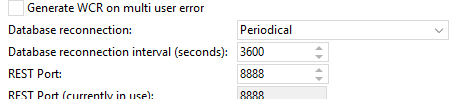
During the upgrade, the value of this property is converted from hours to seconds. For example, if the setting was 1 hour, it will now be 3600 seconds.
The reconnection mechanism can now also be used by the REST workers on REST services. If the Database reconnection is set to Periodical and the database loses connection and
-
cannot reconnect, the service log for the worker will state: Cannot reconnect to database.
-
can reconnect, the service log will state: Periodically reconnected to database.
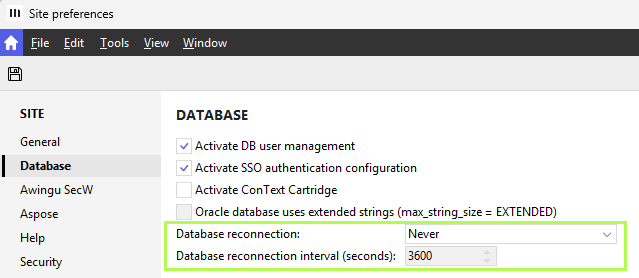
The properties have also been added to the Database tab of the site preferences so they can be used for logged-in users. By default, it is not initialised after the upgrade. When it is set to Periodical, the system reconnects automatically after each interval, regardless of whether the connection was lost or not, in order to keep the memory usage low.
Performance tracing moved to new tab
In a previous version, settings were introduced to enable performance tracing on the BAPI services and configurable REST services.
These settings have been moved to a designated tab called Tracing. The properties themselves have not changed.
REST exchange log field moved to appropriate logging tab
Previously, in the service configuration navigator for REST services, the Creation of REST exchange log entries mode field was located under the Security tab, even though it has nothing to do with security settings. This issue has been fixed in this version. This field has been moved to the Logging tab under the new REST EXCHANGE LOG ENTRIES group box.
2026r1
Additional metrics on REST exchange logs
To be able to investigate the performance of REST calls, additional metrics have been added to the REST exchange log entries in the navigator:
-
Received timestamp:
The date and time on which the call was received by Mediagenix Base. -
Queue duration:
The amount of time that the call was in the queue to be processed. More specifically, this is the difference between the Created on and Received timestamp.
Note that, for comparison, the Response duration is how much time it took from the moment the system started processing the call until a response is sent back to the external system.
-
Trace parent:
The value of thetraceParentheader of the call, if it was present. This header allows tracing a REST call more easily through multiple systems. -
Worker:
An indication of which REST worker processed the call.
Fix for using null as value for point-in-time custom attributes in BAPI
Previously, when defining a point-in-time custom attribute on a concept that has an API that supports custom attributes (content, copyright, MAM, on-demand schedule, person and trailer), and sending null as its value in a POST or PUT call, this would crash the system.
This issue has been fixed in this version. The custom attribute is cleared in this case.